Introduction
Hello there 👋#
Welcome to our ToOp (engine) repository at Elia Group.

A short intro - what is ToOp about?#
ToOp is short for Topology Optimization and describes the approach to reduce grid congestion by topological actions. Topological actions are non-costly actions that can be applied to the grid to "steer" the electrcitiy flow. Our goal is to propose (potentially) new topology strategies to the operators with the goal to lower redispatch costs and carbon emissions.
This repository builds the engine behind the topology optimization product ToOp at Elia Group. ToOp provides tools to perform topology optimization on operational grid data through an importer, a DC optimization stage, and AC validation. It also includes the GPU-based DC load flow solver. At the current stage it considers transmission line switching, busbar splitting, busbar reassignments, and linear PST tap optimization. For Powsybl-imported grids, we additionally support grouped optimization of PSTs.
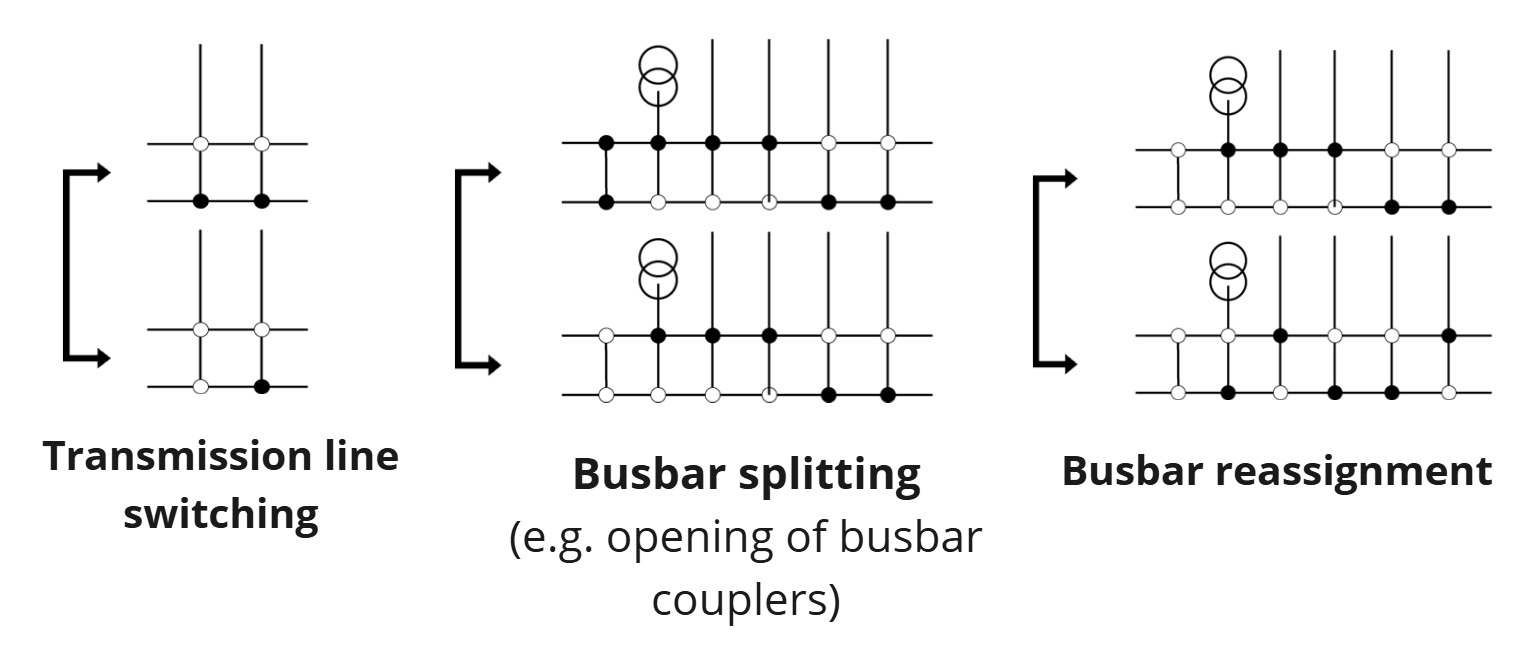
About this repository#
This repo builds the engine behind the topology optimization project ToOp at Elia Group. The standard workflow first normalizes a raw grid into a processed grid folder containing the backend grid snapshot, masks, loadflow parameters, topology metadata, and an initial contingency definition. The DC preprocessing stage then adds static_information.hdf5, action_set.json, action_set_diffs.hdf5, and the final nminus1_definition.json used by the solver, optimizer, and postprocessing. Note that this does NOT provide a GUI or system integration code, you are expected to interact with the module through either python or kafka commands. You can check the paper for a high level academic introduction.
Please check out our full documentation.
Getting Started#
If you want to get started with the engine, we highly recommend checking out our example notebooks.
Prerequisites#
If you want to contribute to this repository, we recommend using VS Code's Devcontainer Environment. This allows the developers to use the same environment to develop in.
For this setup, you need to install:
1. uv
2. Microsoft VS Code
3. Docker
Installation#
You can follow our installation guide on our Contributing page.
Usage#
In order to understand the functionalities of this repo, please have a look at our examples in notebooks/.
There you can find several Jupyter notebooks that explain how to use the engine.
For example, you can import a grid file, build the preprocessing artifacts, and compute the DC loadflow using our GPU-based loadflow solver.
Or you can load an example grid, including the grouped-PST Powsybl example, and minimise the branch overload by running the topology optimizer.
You can also build the documentation and open it on your web browser by running
Useful resources#
The following resources may be helpful to grasp the key concepts:
- Quickstart: Grasp the basics and follow along examples. The first one take you through a DC loadflow computation using the DC Solver package.
- Usage: Learn about the two different ways to use this software, either via python or kafka.
- Topology Optimizer: Understand the key concepts behind the topology optimizer.
- Presentation ToOp @ LF Energy 2025
- Presentation ToOp @ LF Energy 2024
Note: This project does not provide a GUI or system integration code. You are expected to interact with the module through either python or kafka commands. This might come in the future if there is an interest from the community.
High-level architecture#
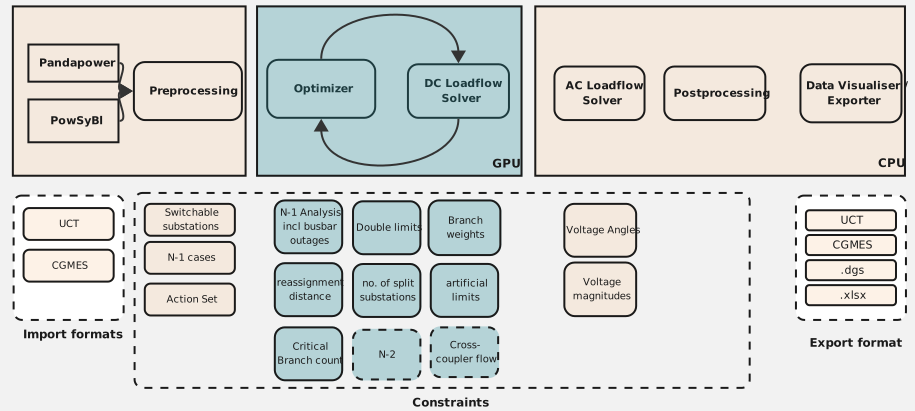
The topology optimizer takes as an input operational grid files (e.g. UCT, CGMES) which are imported by open-source libraries (PowSyBl, pandapower) and normalized into a processed grid folder. The importer stage writes the backend grid snapshot together with masks, loadflow parameters, and topology metadata; the DC preprocessing stage adds static_information.hdf5, action_set.json, and the final contingency definition. The pre-processed files are then optimized in a GPU-native set-up (optimizer + GPU-based load flow solver). The optimal results are stored as a pareto-front, so a set of all solutions that are "Pareto optimal". This means that no other solution exists that improves at least one objective without worsening another one. These results are then validated and filtered using an AC power flow. In the end the results are displayed in a frontend where an end user can review and evaluate the proposed actions. The proposed topological actions can then be exported to other systems.
Description the GPU-based DC load Flow solver#
The GPU-based DC Load Flow solver serves the purpose of computing a large number of similar DC load flows in an accelerated fashion. Currently the solver supports the following batch dimensions, i.e. the workload must not change in anything other than these dimensions: • Branch topology (assignment of branches to busbar A or B) • Injection topology (assignment of injections to busbar A or B) • Branch outages
Under the hood, it is using PTDF/(G)LODF/BSDF approaches to achieve this. If your workflow suits these requirements like it is the case for topology optimization, this solver can help you out.
Roadmap#
Next to some smaller improvements, current work focuses on broadening controllable asset support, improving preprocessing fidelity, and hardening the end-to-end optimization workflow: - Support of a wider range of asset topologies by refactoring the our abstraction layer - Support of optimization of non-linear and/or asymmetric phase-shifting transformers
We will work on sharing a more high-level roadmap in the future.
Let us work together#
We strongly believe that through joint development, collaboration and integration into other tools, we can jointly build an open-source topology optimizer that is fast, provides accurate recommendations and can be used by different TSOs to reduce grid congestion. Topology optimization works best when holistically applied to the grid and the different operational constraints from different TSOs are considered. This is why we invite you to share your feedback, constraints and your approaches so that we can jointly improve ToOp.
In addition, we also see the opportunity that ToOp can be combined with other open-source tools. If you have ideas, reach out us.
We invite you to test it, ask questions and provide feedback to us. And if you like it, we invite you to contribute to the development. We are looking forward to hearing from you.
Finding help#
If you require help with using this package, your first point of contact is ToOp@eliagroup.eu.
Contributing#
Please have a look at our Contribution Guide.
License#
Distributed under MPL 2.0. See LICENSE.
Citation#
If you use our work in scientific research, please cite our paper on load flow solving and soon also the work on the optimizer architecture, which is to be released soon.
Contact#
Team – ToOp
Acknowledgments#
We credit the authors of JAX.